
Frost Heave and Why New England Hardscaping Fails
Water expands nine percent when it freezes. Multiply that across a base full of trapped moisture and you can lift a slab of bluestone.
Every spring we get calls about a patio corner that dropped, a walkway that lifted, or a retaining wall that started to lean. Almost every one traces back to the same physics, and almost every one was preventable at construction.
The mechanism
Water expands roughly nine percent when it freezes. That much is common knowledge. What matters for hardscaping is where that expansion happens and what it pushes against.
When soil freezes, water in the pore spaces turns to ice. In fine-grained soils — silt and clay — something worse happens. Unfrozen water gets drawn upward toward the freezing front by capillary action and freezes there, forming ice lenses that grow. Those lenses can lift the ground above them by inches.
That is frost heave. It is not just expansion in place. It is water actively migrating to the freezing zone and accumulating there.
Why it needs three things
Frost heave requires all three of these simultaneously:
- 1Freezing temperatures penetrating the soil
- 2Frost-susceptible soil — fine-grained material with capillary action
- 3A water supply feeding the freezing front
You cannot do anything about the first one in Massachusetts. The other two are entirely within a builder's control, and that is the whole strategy: use non-frost-susceptible base material, and keep water from accumulating in it.
Why base material choice matters
Angular processed gravel — dense-graded crushed stone with a range of particle sizes — is the standard base material for good reason. The angular faces lock together mechanically when compacted, giving structural strength, and the material is largely free of the fines that support capillary rise.
Round pea stone does not interlock; it rolls. Stone dust compacts hard but holds water. And native soil, especially clay-heavy till, is the worst possible base because it is both weak and highly frost-susceptible.
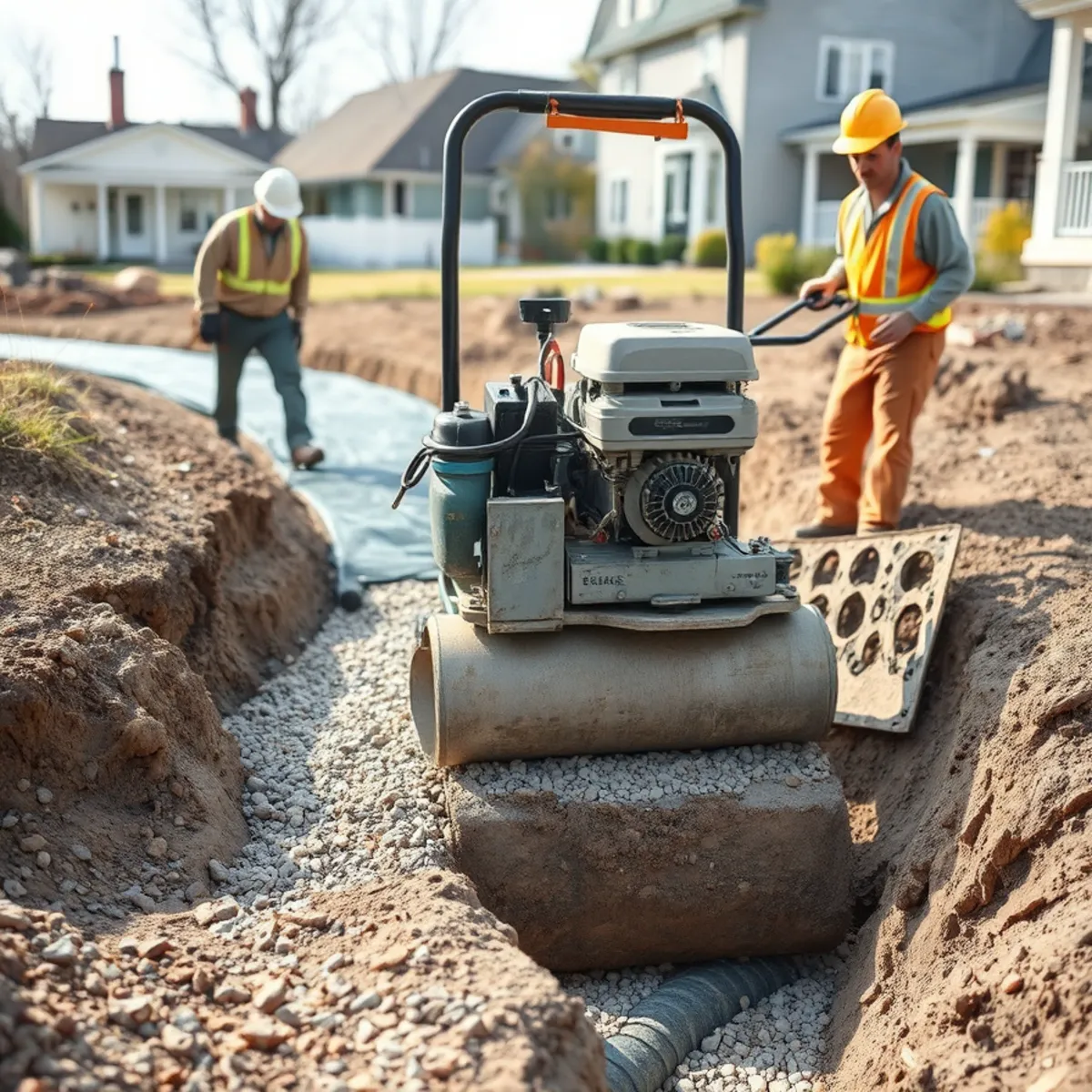
Compaction has to happen in lifts. Three to four inches at a time, plate-compacted between each. Compaction energy from a plate compactor only penetrates so far — dump twelve inches and compact the top and the bottom two-thirds stays loose. That patio settles as the loose material consolidates under traffic, and no amount of surface work fixes it.
The fabric layer nobody sees
Geotextile fabric between the base stone and the native subgrade does something simple and important: it separates them.
Without it, over years of freeze-thaw and load cycling, base stone works down into soft subgrade while soil fines migrate up into the base. Both processes degrade the base — you lose thickness and you gain exactly the fine material that makes it frost-susceptible. The base slowly turns into the soil it was supposed to be protecting the patio from.
Fabric costs very little relative to the job. On clay or soft organic soil it is not optional.
Water has to have somewhere to go
The base can be perfect and still fail if water accumulates in it. Three things move water out:
Surface pitch
About an eighth of an inch per foot of fall away from the house. Enough to shed water, not enough to feel underfoot. A dead-level patio ponds. A patio pitched toward the house sends every rainstorm at your foundation.
Drainage within the base
On wet sites, a perforated pipe in the base collecting water and carrying it to daylight or a drywell — the drainage work that decides whether a patio survives. This is the step most often skipped and it is the difference-maker on the clay-heavy lots around Whitman and the low-lying areas near the meadows and the Shumatuscacant.
Joint material that stays put
Polymeric sand binds when activated with water and resists washing out. Standard mason sand washes out of the joints, which lets surface water pour straight into the base and turns the joints into a seedbed for weeds.
Walls have their own version of this
A retaining wall fails from behind, and the force is mostly hydrostatic pressure rather than soil weight. Saturated soil behind a wall with no drainage path pushes hard, and freezing multiplies it.
The four non-negotiables on any wall:
- A compacted base course set below finished grade, so the bottom of the wall is buried
- Twelve inches of free-draining crushed stone behind the wall face
- Geotextile fabric separating that stone from native soil
- A perforated drain pipe at the base, pitched and daylighted somewhere useful
Backfill a wall with the soil you excavated and you have built a dam. The water has nowhere to go, and every freeze pushes the wall outward a little more.
Steps take the worst of it
Steps concentrate load into a small footprint and sit at grade changes where water naturally collects. They are the first thing to move on most properties.
They need a deeper and wider base than the flat work they connect to, and on frost-prone sites they benefit from a compacted footing pad below the zone where frost does the most work.
Can existing damage be fixed?
Often, yes. If the surface material is undamaged, we lift it, rebuild the base properly with fabric and drainage, and reset the same stone. Pavers in particular come up and go back down cleanly.
If the base failed because there essentially was not one, rebuilding is the honest answer, and we will say so rather than doing a surface repair that fails again the following spring.
The short version: everything about durable hardscaping in this climate comes down to keeping water out of the base and giving it a path when it gets in. That is why our patio and walkway proposals specify base depth and drainage in writing — those are the lines that determine whether the project is still flat in fifteen years.
Frequently Asked Questions
Six inches of compacted processed gravel is a reasonable minimum on well-drained soil. Clay-heavy sites, high water tables, and any area carrying vehicle loads need more — commonly eight to twelve inches, installed in compacted lifts.
Usually a base that was too thin, not compacted in lifts, or built without drainage on a site that needed it. Water accumulated, froze, lifted the surface, and left a void when it thawed. The fix is rebuilding that section of base properly and resetting the stone.
No. Sealer affects the surface — color, stain resistance, and joint stabilization — not the base. Frost damage happens below the pavers, and no surface treatment addresses it.
Want this handled for you?
We do this work across Whitman and the South Shore every week. Call (323) 606-0255 for a free on-site estimate — we will tell you honestly what your property needs.