
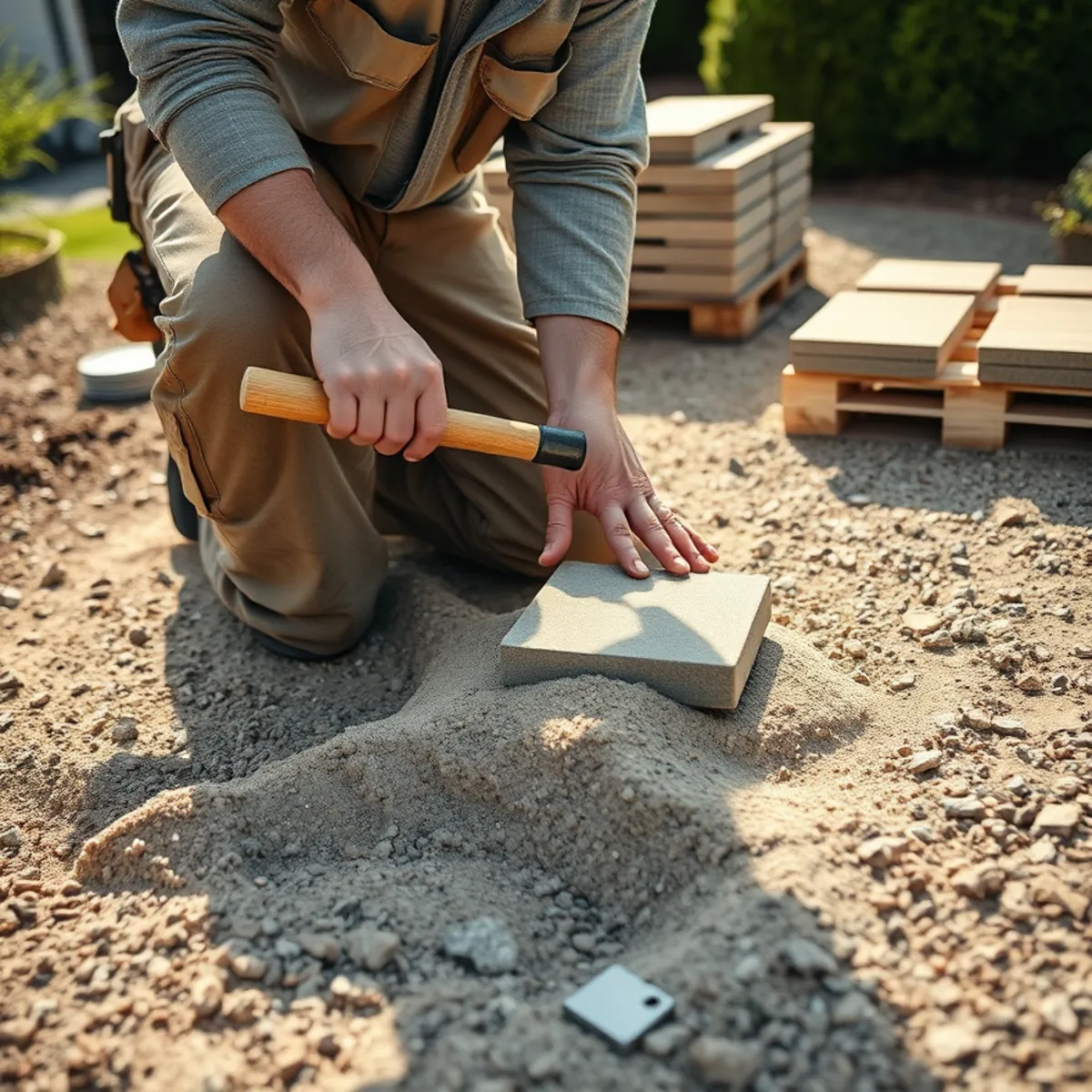
Whitman, MA · April–November
Walkways & Garden Paths in Whitman, MA
The most-used hardscape on any property, and the first thing a visitor steps on. Built on a base deep enough that New England frost does not lift it.
5.0★
28 Google reviews
Not one below five stars
15+
Years in business
Serving the South Shore since 2010
Free
On-site estimates
Written scope, firm number
12
Months a year
Lawn care through snow removal
Overview
Walkways & Garden Paths in Whitman, MA
A walkway gets walked on more than any other hardscape you own, it is the first thing a visitor steps on, and it is the surface most likely to be covered in ice four months of the year. It deserves more engineering than it usually gets.
Almost every failed walk we are called to look at failed for the same reason: not enough base. A path is narrow, so the frost reaches under it from both sides as well as from above. That makes a walkway more vulnerable to heaving than a patio of the same construction, not less — which is exactly backwards from how most of them get built.
We build walks in bluestone, brick, concrete paver and fieldstone, and we rebuild the ones that have already lifted. Which material is right depends on the house, the budget and how much winter maintenance you want to do.
What's included
- Front entry walks, garden paths and side-yard connectors
- Natural bluestone — thermal, pattern-cut or irregular
- Clay brick in running bond, herringbone or basketweave
- Concrete pavers where budget or a specific colour range matters
- Fieldstone and steppers set into lawn or groundcover
- Steps, landings and the transition where a walk meets a driveway or patio
- Re-levelling and repair of heaved or settled existing walkways
- Full base rebuild where an old walk has failed from underneath
- Edge restraint so the outer course cannot migrate
- Polymeric jointing to slow weed growth and hold the joints
- Drainage so water sheds off the surface instead of sitting on or under it
- Conduit sleeves run under the walk during construction for future lighting
- Full restoration of the lawn and beds either side when we finish
What we see
Why walkways fail, and what each symptom means
A walk rarely fails at the surface. By the time you can see the problem, the cause is usually a foot underneath it.
Slabs or pavers lifting at the joints
Classic frost heave. Water held in the base froze and expanded. It means the base is too shallow, too fine, or holding water — often all three. Re-setting the surface without fixing the base buys you one season.
A low spot that holds water or ice
The base settled, usually because it went in too thick in one lift and never compacted properly, or because the subgrade underneath was soft topsoil that was never dug out.
The walk is simply too narrow
A great many older front walks are 30 inches wide, which means two people cannot walk side by side and nobody can carry anything comfortably. Three and a half to four feet is the width that actually gets used.
Slippery green film every spring
Algae on a shaded, damp walk. It is a drainage and light problem rather than a cleaning problem. Widening the bed either side, limbing up what is shading it, or changing to a more textured surface all do more than another pressure wash.
Cracked mortar on an older mortared walk
Mortared walks on a slab are rigid, and rigid assemblies crack when the ground moves. A dry-laid rebuild on a proper base flexes with the frost instead of fighting it, which is why we rarely recommend re-mortaring.
Weeds and ants in every joint
Open joints filled with ordinary sand. Polymeric jointing, properly installed and watered in, closes them. It is not permanent, but it turns a monthly job into an occasional one.
Walkways & Garden Paths in action
Our process
How we build a walkway
The visible part takes a day. The part that determines whether it is still flat in fifteen years happens before anything gets set.
- 1
Walk the route with you
Where people actually walk matters more than where the old walk is. If there is a worn path across the lawn, that is the route telling you something. We also check where snow gets pushed and where roof water lands.
- 2
Lay out line and width
We mark the shape with paint and let you look at it from the street and from the door before anything is dug. Curves are easy to get wrong on paper and obvious on the ground.
- 3
Excavate to depth, not to convenience
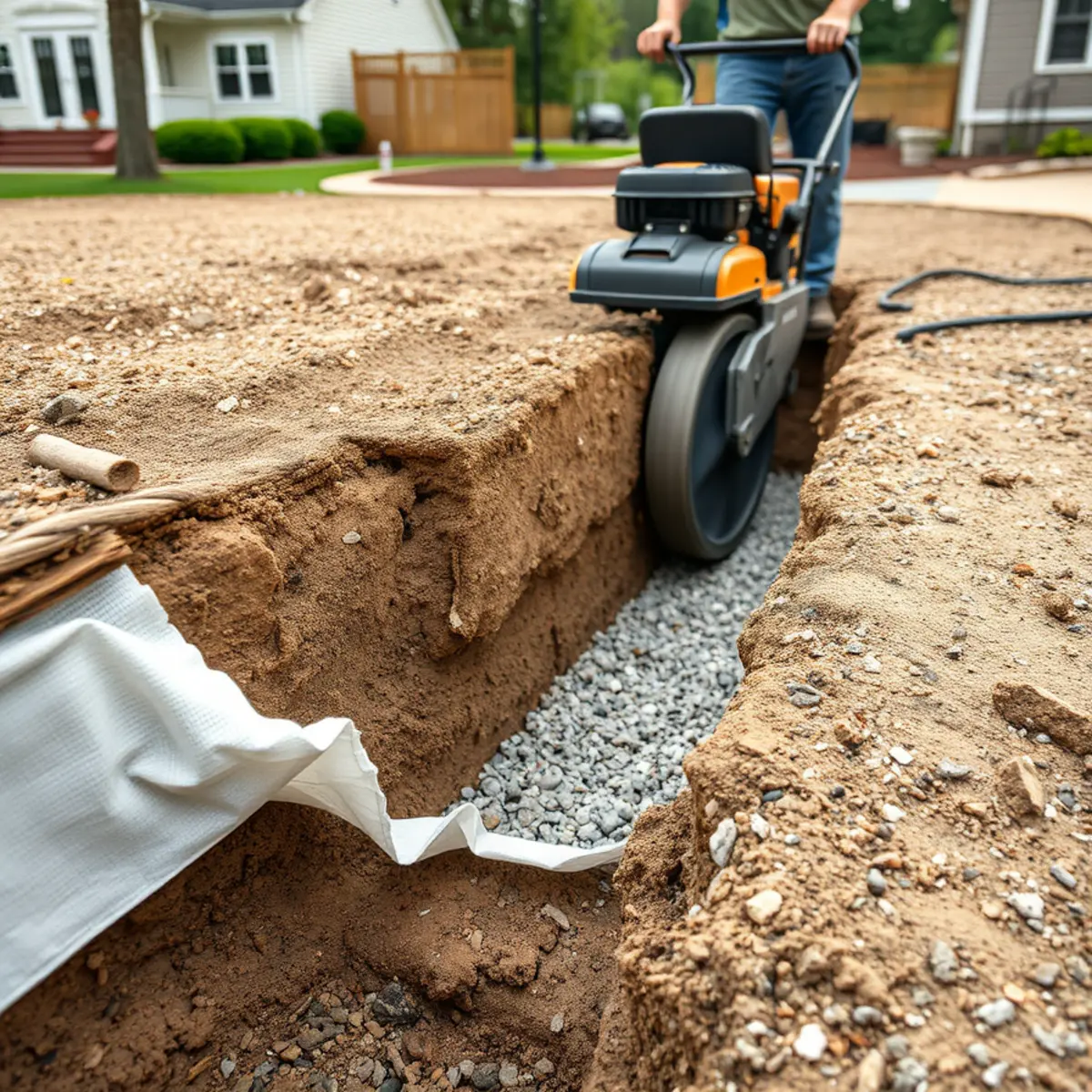
All topsoil and organic material comes out. On most South Shore subgrades that means ten to twelve inches of excavation for a walk, more where the ground is soft or the walk carries a step.
- 4
Base in compacted lifts
Processed gravel placed in lifts of a few inches and compacted each time, over geotextile fabric where the subgrade is fine or wet. Dumping the full depth and running a plate over the top once is the single most common shortcut and the single most common cause of failure.
- 5
Screed the bedding layer
A thin, consistent bedding course screeded flat. Thin is deliberate — a deep sand bed is not a base, it is a sponge, and it is where a lot of walks go wrong.
- 6
Set the material
Stone or paver set to line, with pitch held away from the house so water sheds. Cuts are made with a wet saw rather than snapped, because the cut edge is the one you will be looking at.
- 7
Edge restraint and jointing
A restraint along both edges so the outer course cannot creep, then polymeric jointing swept in, compacted and watered to set.
- 8
Restore everything either side
Loam, seed or sod and a clean bed edge along the full length. A new walk with a trench of bare dirt beside it is a half-finished job.
Local expertise
Why walkways heave more than patios
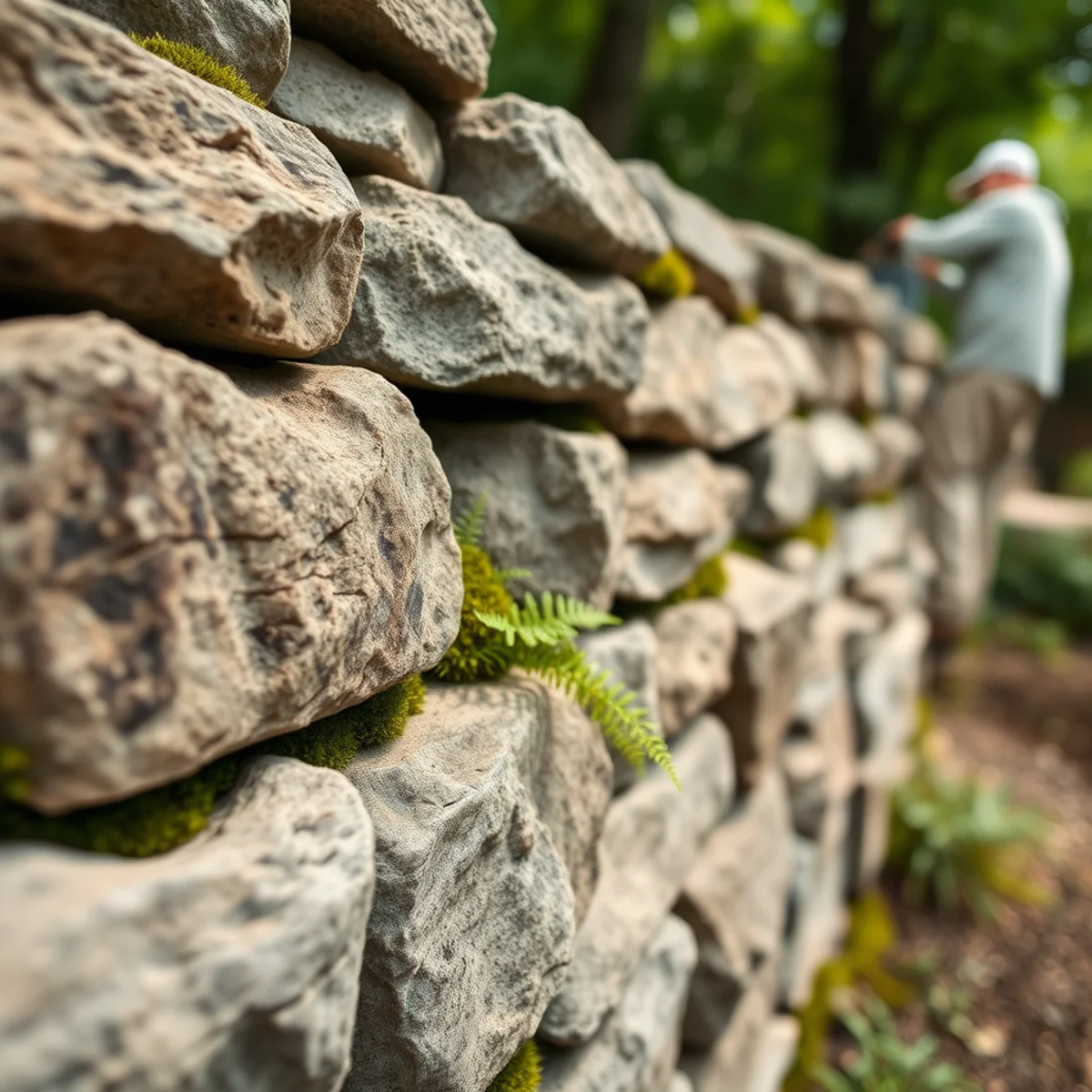
Frost depth in southeastern Massachusetts runs to roughly four feet in a hard winter. Nobody excavates a walkway four feet deep, so no walk is truly below frost — the goal instead is a base that drains fast enough that there is no held water to freeze.
The reason a narrow walk is more vulnerable than a wide patio comes down to geometry. A patio has a large interior area insulated by its own mass and by whatever snow sits on it. A walkway is narrow enough that cold reaches it from above and from both sides, and it is the surface most likely to be shovelled bare in January, which removes the snow that would otherwise insulate it. Same construction, far harsher exposure.
That is why we build walks to the same base depth we would use for a driveway apron rather than the shallower section some crews use for a path. It is more excavation and more gravel than a cheaper bid will include, and it is the difference between a walk that is flat in year fifteen and one that is a trip hazard in year three.
It is also why we are blunt about mortared walks on concrete slabs. They look permanent and they are the most likely of all to crack, because a rigid assembly has nowhere to go when the ground beneath it moves. A dry-laid walk moves a fraction of an inch and settles back.
Why Giachetto Landscape
Why people have us build their walkway
15+ years on South Shore properties, 5.0 stars from 28 Google reviews, fully insured, and the owner on the job rather than behind a desk.
We dig the base a cheaper bid will not
The base is invisible the day the job finishes and it is the only thing that determines whether the walk is still flat in a decade. It is the main reason our number differs from the lowest quote, and we will show you the spec rather than ask you to take it on faith.
We will tell you when a repair beats a rebuild
Plenty of walks have a sound base and a settled section. Lifting, re-screeding and re-setting that section costs a fraction of a replacement. We say so when it is true, which costs us the bigger job and keeps the client.
The material gets matched to the house
Bluestone in front of a 1960s ranch and stamped concrete in front of an antique colonial both read wrong no matter how well they are installed. We choose with the architecture rather than from whatever is on the pallet this month.
We leave the edges finished
Loam, seed and a cut bed edge the full length on both sides. A new walk with a scar of bare dirt beside it is a job that stopped one step early, and it is how most of them get left.
- 5.0 stars28 Google reviews
- 15+ yearsServing the South Shore since 2010
- Fully insuredCertificates on request
- Locally ownedBased at 23 Rowena Ave, Whitman
Honest pricing
What actually drives the price of a walkway
We do not quote walkways by the square foot over the phone, because two walks of identical size can differ by thousands for reasons that are invisible from a photograph.
Length and width
Square footage is the starting point, but widening a walk from three feet to four adds a third more of everything — excavation, base, material and labour.
Material
Concrete paver is the most economical. Clay brick sits in the middle. Full-thickness natural bluestone is the most expensive and the longest-lived. The material is usually a smaller share of the total than people expect.
What is under it now
A walk over firm sandy subgrade needs less excavation than one over soft loam or clay. We do not know which you have until we open it, which is why the estimate is on site.
Steps and grade change
Every step is its own small structure with its own base and its own drainage. A walk with three steps and a landing is a materially different job from a flat run of the same length.
Curves and cuts
A curved walk means every unit along both edges is cut individually. It looks better and it costs more; a straight run with a soldier border is a legitimate way to save money.
Access
If a machine can reach the work, base and spoil move quickly. If everything has to go through a gate by wheelbarrow, the labour changes substantially.
Removing what is there
Breaking out and carting away an old concrete or mortared walk is real demolition cost before any new work starts.
Every walkway estimate is free, on site and written. We will tell you honestly when re-levelling the walk you have is the better value than replacing it.
Social proof
28 Reviews, 5.0 Stars
Every review on our Google Business Profile is five stars. Here is a sample.
Read them on Google“The Giachetto Landscape crew did an absolutely incredible job on a big spring cleanup at our home. The yard was a mess, and there wasn't a single leaf or stick left in any nook or cranny once they were done. They were efficient, respectful, fast, and reasonably priced. We're blown away by how hard they worked. There are so many landscaping companies to choose from, and we couldn't be happier to have found such an amazing crew! 10/10!”
Mia Gallo· Google review
“Chris did an amazing job installing my new lawn with sod. From him being readily available to take a look at my job in the beginning, to providing me a prompt, competitive quote, to the pulling up of my old weed filled lawn, hand laying the new sod, and setting up of the sprinklers/timers to water the lawn, he has been a pleasure to work with. He also pulled out a large shrub and planted a smaller one, as well as re-mulched. He is professional, responsive to all questions, easy to work with, and a hard worker. I highly recommend him for any landscape project you may have.”
Laurie K· Google review
Answers
Walkways & Garden Paths: Common Questions
Specific to walkways & garden paths on South Shore properties.
Three and a half to four feet for a main entry walk. That is the width where two people can walk side by side and where someone carrying grocery bags does not have to step onto the lawn. Thirty-inch walks, which are extremely common on older South Shore houses, are the single most frequent reason people replace a walk that is otherwise sound.
Full-thickness natural bluestone, by a wide margin, and it is also the most expensive. Clay brick holds its colour permanently because the colour is the material rather than a surface treatment. Concrete pavers are the most economical and will fade somewhat over fifteen or twenty years. All three outlast their base if the base is wrong, so the construction matters more than the choice.
Often, yes. If the base is sound and a section has settled or heaved, we lift that area, correct the base, re-screed and re-set the same material. If the whole walk is moving the base is the problem and a repair is money spent twice — we will tell you which one you have after we open a section.
A properly built dry-laid walk handles shovelling and a snowblower without trouble. Metal shovel edges can chip the arris on natural stone over many years, so a poly-edged shovel is worth using. Avoid rock salt on new stonework in the first winter and prefer calcium chloride, which is gentler on the joints.
A straightforward entry walk is usually two to three days — one for demolition and excavation, one for base and compaction, one for setting and jointing. Steps, curves or a long run add time. We do not set material the same day we excavate, because the base needs to be built and compacted properly rather than rushed.
Yes, and it is far cheaper to do it during construction than afterwards. We run empty conduit sleeves under the walk at the points where fixtures are likely to go. Even if you are not installing lighting now, the sleeves cost very little and save cutting the walk open later.
Related services and articles
Related services
Hardscaping: Patios & Walkways
Paver and bluestone patios, walkways, steps, and fire pits — built on a base that survives twenty New England freeze-thaw cycles.
Retaining Walls & Steps
Block and natural stone walls that hold a grade for decades — with the drainage stone, fabric, and base most bids leave out.
Landscape Design & Planting
Beds and foundation plantings designed around your actual light, soil, and how big things get in ten years — not how they look on the truck.
Drainage Solutions & Grading
Standing water, soggy lawns, and water against the foundation — solved by moving water somewhere it belongs, not by hiding it.
Further reading
Bluestone, Brick or Concrete Paver: Choosing a Walkway Material for New England
Three materials, three very different answers depending on the house, the budget and how much winter maintenance you are willing to do.
Frost Heave: Why New England Hardscaping Fails
Water expands nine percent when it freezes. Multiply that across a base full of trapped moisture and you can lift a slab of bluestone.
What Drives the Cost of a Paver Patio in Massachusetts
The difference between a cheap patio quote and an expensive one is almost always what is under the stone. Here is how to read a bid.
Where we do walkways & paths
We build and repair walkways across the South Shore and into Norfolk and Bristol counties — Whitman and the surrounding towns, the coastal properties in Hingham, Scituate and Duxbury where maritime freeze-thaw is hardest on stonework, and the older housing stock in Wellesley, Needham, Brookline and Milton where matching the period of the house matters. See every town on our service areas page.
Free estimate
Request a Free Walkways & Paths Estimate
Tell us about the property and we will set up an on-site visit. Every request gets a reply within one business day.
- ✓Free on-site estimate with a written scope
- ✓5.0★ from 28 Google reviews
- ✓15+ years working South Shore properties
- ✓Fully insured — certificates available on request
Get Walkways & Paths Handled Properly
Call (323) 606-0255 to talk it through, or request a free on-site estimate and we will come look at the property.
- 5.0★ · 28 reviews
- 15+ years experience
- Fully insured
- Free on-site estimates