
Whitman, MA · Spring through late fall
Drainage Solutions & Grading in Whitman, MA
Standing water, soggy lawns, and water against the foundation — solved by moving water somewhere it belongs, not by hiding it.
5.0★
28 Google reviews
Not one below five stars
15+
Years in business
Serving the South Shore since 2010
Free
On-site estimates
Written scope, firm number
12
Months a year
Lawn care through snow removal
Overview
Drainage Solutions & Grading in Whitman, MA
Drainage is the least glamorous work we do and the most consequential. A wet yard is not just an inconvenience — it kills lawns, rots plant roots, undermines patios, breeds mosquitoes, and eventually finds your basement.
Whitman has a genuine water table and soil situation. Much of the eastern half of town drains toward the Shumatuscacant River, Hobart Meadow and Bear Meadow hold water well into spring, and a lot of properties sit on glacial till with enough clay to hold water like a bowl. When someone tells us their yard "just doesn't drain," they are usually describing that.
The right fix depends entirely on where the water comes from and where it can go. Our first visit is a diagnosis, not a sales call.
What's included
- Site assessment — ideally during or right after rain, when we can see the actual flow
- Surface regrading to establish positive pitch away from foundations and out of low spots
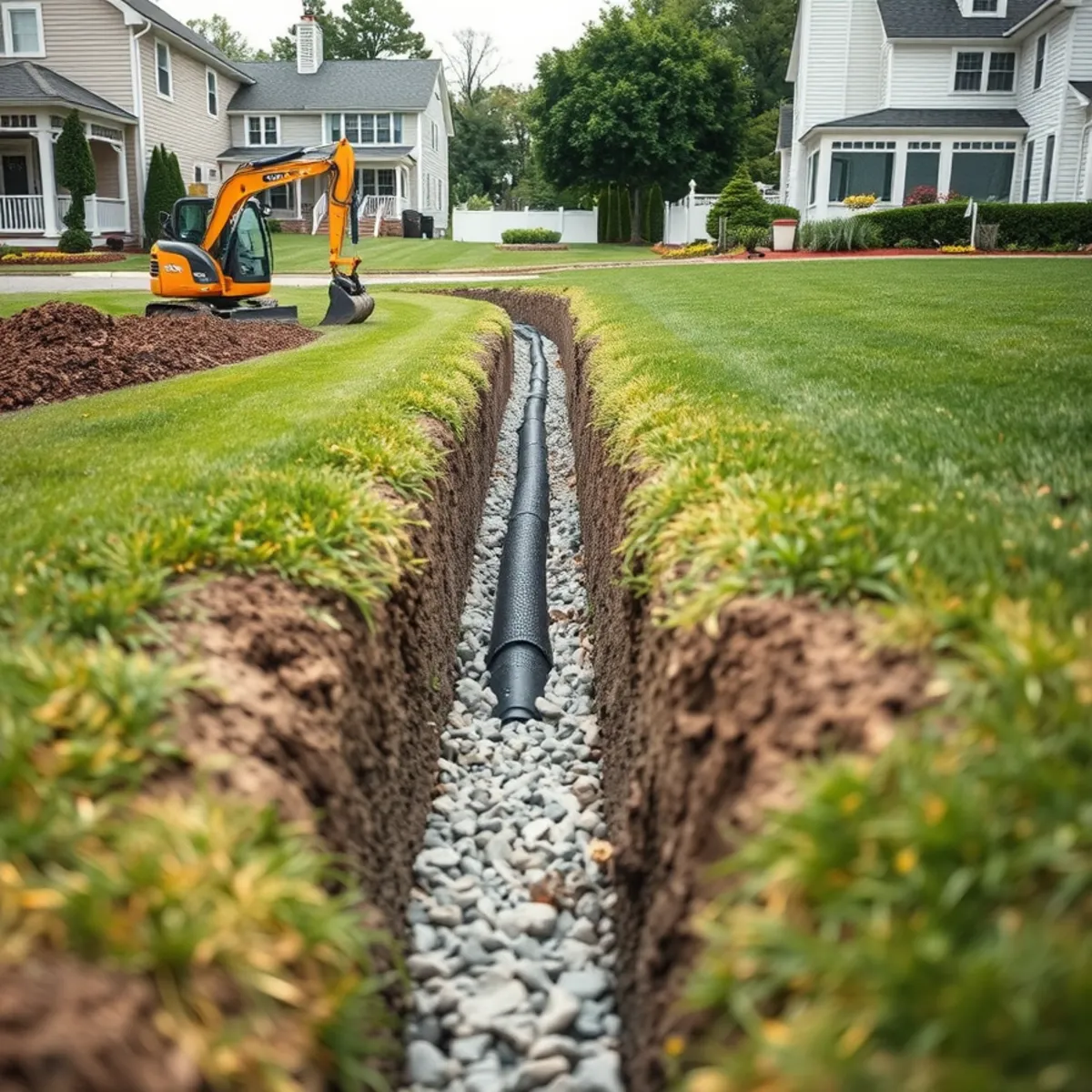
- French drain installation with perforated pipe, washed stone, and filter fabric
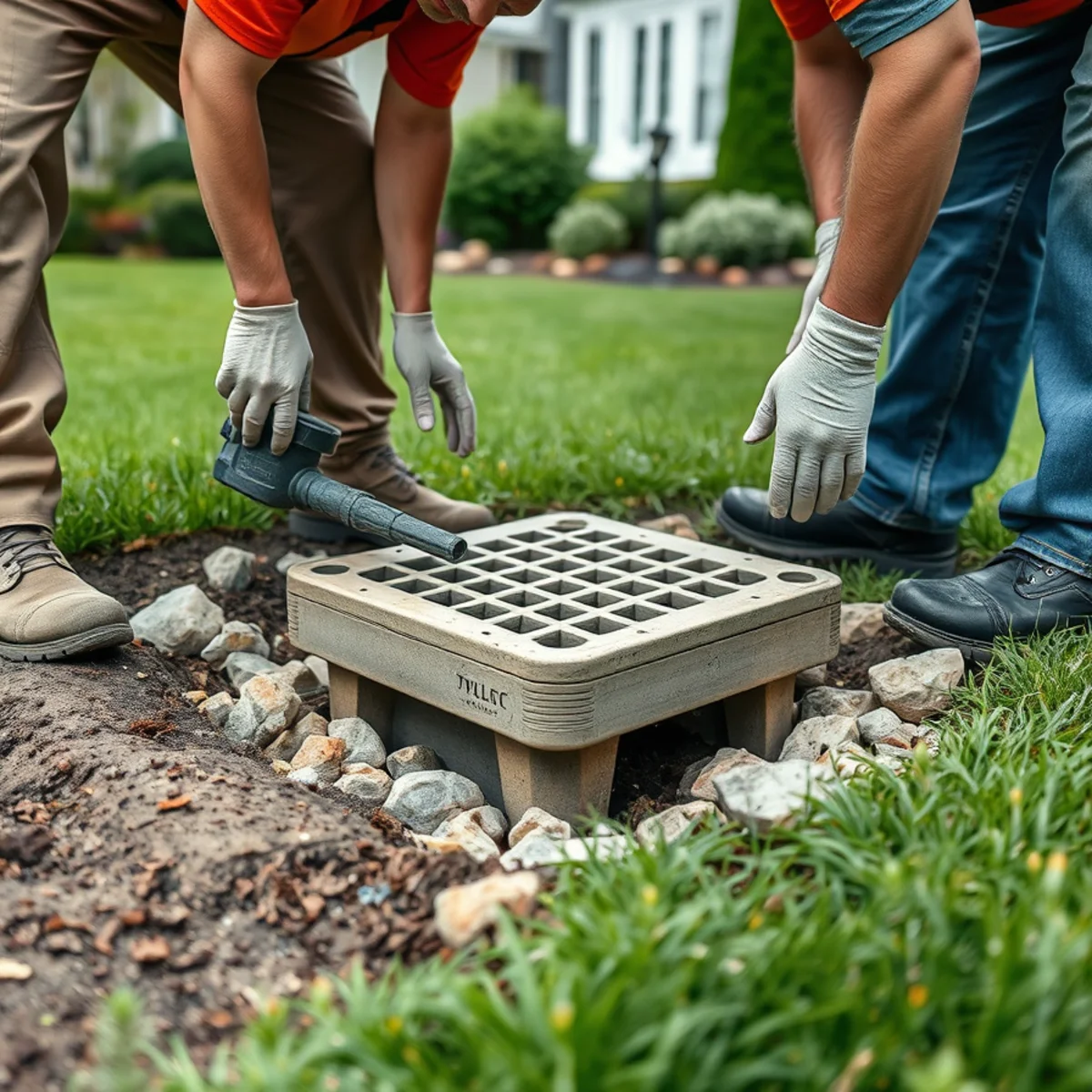
- Catch basins and area drains at low collection points
- Solid pipe runs to daylight or to a drywell
- Drywell and infiltration chamber installation where there is no daylight outlet
- Downspout extensions buried and routed away from the house
- Dry creek beds and swales that handle water while looking intentional
- Sump pump discharge lines routed away from the foundation instead of into the yard
- Full lawn and bed restoration over every trench
What we see
Drainage problems and what causes them
Each of these has a distinct cause. Getting the diagnosis right is most of the job.
Standing water days after rain
Either a low spot with no outlet, or soil that will not percolate. The fix is regrading if there is somewhere for water to go, and a drain to an outlet or a drywell if there is not.
A wet basement or damp foundation wall
Usually starts outside. Grade pitched toward the house, downspouts dumping at the foundation, or a window well with no drainage. Correcting the exterior fixes far more basements than interior sealing does.
Erosion channels cutting across the lawn
Concentrated flow with too much velocity. The answer is to slow it and spread it — a swale, a dry creek bed, or an intercepting drain upslope.
Moss taking over instead of grass
Moss is a symptom, not a disease. It means chronically wet, shaded, compacted, acidic soil. Killing the moss without fixing the drainage and pH just gets you bare dirt.
A soggy strip along the driveway or patio
Hard surfaces shed all of their rainfall to their edges. Without a drain along that edge, the adjacent turf absorbs the runoff from the whole slab.
Sump pump water recycling back to the house
A sump discharging six feet from the foundation just puts the same water back into the ground it came from. It needs to be piped well away, to a real outlet.
Drainage Solutions & Grading in action
Our process
How we solve a drainage problem
The diagnosis takes longer than most contractors spend on it, and it is why our fixes work.
- 1
Find the source
Roof water, driveway runoff, a neighbor's grade, groundwater, or a spring — each needs a different answer. We look at gutters, downspouts, the slope of everything upstream, and the soil profile.
- 2
Find the outlet
Water has to go somewhere legal and sensible. Daylight on a lower part of the property is ideal. If there is none, we design for infiltration on-site with a drywell sized to the volume.
- 3
Test the soil
A percolation test tells us whether a drywell will actually work. Heavy clay may need a different approach entirely.
- 4
Design the system
Pipe size, trench depth, pitch, stone type, and outlet — specified, not improvised. Pitch matters most: a drain that does not fall consistently holds water and silts up.
- 5
Call Dig Safe, then excavate
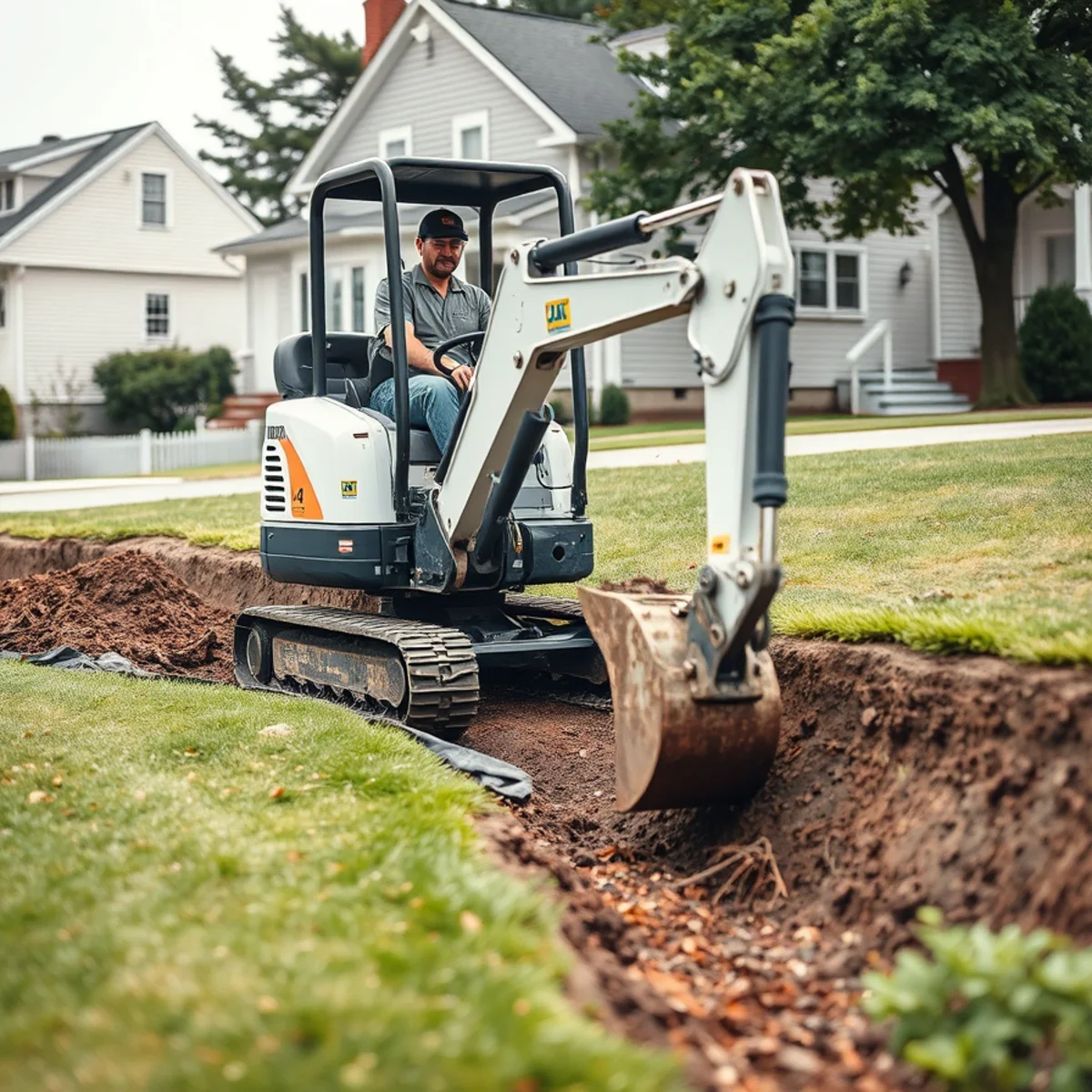
Utility marking before any trench. Then we dig to design depth with consistent grade.
- 6
Build it correctly
Filter fabric lining the trench, washed stone bed, perforated pipe with holes down, stone over the pipe, fabric folded over the top, then backfill. Fabric is what keeps silt out and the system working in year ten.
- 7
Restore the surface
Loam and seed or sod over every trench, beds put back, hard surfaces cleaned. When we are done the yard should not look like it was dug up.
Local expertise
French drain, drywell, or regrading — which one you actually need
These three get used interchangeably and they solve different problems. Choosing wrong is how people spend money and still have a wet yard.
Regrading is the first thing to consider and the most overlooked. If water is sitting in a low spot and there is somewhere lower nearby, reshaping the surface to move it there is cheaper and more reliable than any pipe. Grade should fall away from the house at roughly six inches over the first ten feet. A surprising number of "drainage problems" are just a settled grade against a foundation, fixable with loam and a rake.
A French drain is for subsurface water and for intercepting flow. It is a trench with washed stone, perforated pipe, and filter fabric that collects water moving through the soil and carries it away. It is the right tool for a chronically soggy area, for intercepting water coming downhill from an upslope neighbor, and for relieving hydrostatic pressure behind a wall or against a foundation. It is the wrong tool if the real problem is surface water pooling — that wants grading or a catch basin.
A drywell is an underground reservoir — a chamber or a stone pit — that holds collected water and lets it infiltrate slowly into the surrounding soil. It is the answer when there is no daylight outlet anywhere on the property, which is common on flat lots. Its performance depends entirely on how fast the surrounding soil accepts water, so it must be sized off a percolation test. A drywell dug into heavy clay is a hole that fills up and stays full.
Most real projects combine them: catch basins collect surface water, a solid line carries it, a French drain picks up subsurface flow along the way, and everything discharges to daylight or a properly sized drywell. And roof water always gets handled first, because on a typical house it is by far the largest single volume hitting the property — one inch of rain on a 1,500 square foot roof is over 900 gallons, and four downspouts dumping that at your foundation will beat any drain you install downhill.
Why Giachetto Landscape
Why our drainage fixes hold
15+ years on South Shore properties, 5.0 stars from 28 Google reviews, fully insured, and the owner on the job rather than behind a desk.
We diagnose before we quote
Roof water, surface runoff from uphill, a low spot with no outlet, poor percolation, a genuinely high water table, or a sump discharging six feet from the foundation — each needs a different answer. We look at the property during or straight after rain when we can.
Roof water gets handled first
One inch of rain on a 1,500 square foot roof is over 900 gallons. Four downspouts dumping that at your foundation will overwhelm anything built downhill, and extending them is the cheapest high-impact fix there is.
Fabric, washed stone, holes down
Geotextile lining the trench is what keeps silt out and the system working in year ten. Washed stone rather than screened gravel with fines. Perforated pipe laid holes down so it collects from the bottom of the stone bed. Consistent pitch, because a level drain does not drain.
Honest when the answer is to work with the water
On properties near the bogs and ponds the wet area is groundwater, and no system eliminates it. A rain garden or planted wet meadow beats reseeding the same soggy patch every April, and we will say so rather than sell you a drywell that stays full.
- 5.0 stars28 Google reviews
- 15+ yearsServing the South Shore since 2010
- Fully insuredCertificates on request
- Locally ownedBased at 23 Rowena Ave, Whitman
Honest pricing
What drainage work costs
Drainage pricing is driven by linear feet, depth, and what the trench has to get through.
Linear feet of drain
The main measure. Getting from the wet area to a viable outlet is what sets the length, and sometimes the outlet is a long way off.
Trench depth
Deeper trenches mean more excavation, more stone, and more spoil to haul.
What we are digging through
Open lawn is straightforward. Trenching under a driveway, through tree roots, or around an existing patio adds real time.
Whether there is a daylight outlet
A gravity outlet to daylight is the simplest and cheapest solution. No outlet means a drywell, which means excavation, chambers or stone, and more material.
Number of collection points
Each catch basin, area drain, or downspout tie-in is an additional connection to build.
Restoration scope
Sod over trenches costs more than seed but looks finished immediately. Trenching through mature beds means replanting.
Massachusetts wetlands regulations are real, and Whitman has genuinely wet areas. If your project falls within a protected resource area buffer, Conservation Commission review may be required. We identify that during the assessment rather than mid-dig.
Social proof
28 Reviews, 5.0 Stars
Every review on our Google Business Profile is five stars. Here is a sample.
Read them on Google“The Giachetto Landscape crew did an absolutely incredible job on a big spring cleanup at our home. The yard was a mess, and there wasn't a single leaf or stick left in any nook or cranny once they were done. They were efficient, respectful, fast, and reasonably priced. We're blown away by how hard they worked. There are so many landscaping companies to choose from, and we couldn't be happier to have found such an amazing crew! 10/10!”
Mia Gallo· Google review
“Chris did an amazing job installing my new lawn with sod. From him being readily available to take a look at my job in the beginning, to providing me a prompt, competitive quote, to the pulling up of my old weed filled lawn, hand laying the new sod, and setting up of the sprinklers/timers to water the lawn, he has been a pleasure to work with. He also pulled out a large shrub and planted a smaller one, as well as re-mulched. He is professional, responsive to all questions, easy to work with, and a hard worker. I highly recommend him for any landscape project you may have.”
Laurie K· Google review
Answers
Drainage Solutions & Grading: Common Questions
Specific to drainage solutions & grading on South Shore properties.
Two possible causes, sometimes both. Either the spot is a low point with no outlet, or the soil below it does not percolate — common on the clay-heavy till found around much of Whitman. Regrading fixes the first. The second needs a drain to an outlet, or a drywell sized off a percolation test.
Often yes, when the water is coming from outside — which it usually is. The full fix is typically exterior: correct the grade against the foundation, extend downspouts well away from the house, and install a drain to intercept water before it reaches the wall. Interior systems manage water that has already arrived; exterior work stops it earlier.
It depends on the job. Shallow surface interception can work at twelve to eighteen inches. Relieving pressure against a foundation means going to the footing depth. Depth also has to maintain consistent pitch to the outlet — a level drain does not drain.
Yes, and it is usually the single highest-value piece. Downspouts get tied into buried solid pipe and carried well away from the house. Roof water is the biggest concentrated volume on most properties, and dealing with it often solves most of the problem by itself.
Routine regrading and drainage on an upland lot generally does not. If your property is within a wetlands buffer zone — and parts of town near the meadows and the river are — the Conservation Commission may need to review it. We check before we quote.
Related services and articles
Related services
Hardscaping: Patios & Walkways
Paver and bluestone patios, walkways, steps, and fire pits — built on a base that survives twenty New England freeze-thaw cycles.
Retaining Walls & Steps
Block and natural stone walls that hold a grade for decades — with the drainage stone, fabric, and base most bids leave out.
New Lawn Installation: Sod & Hydroseeding
Sod for instant results, hydroseed for value, slice seeding for renovation — with the grading and loam depth the lawn actually needs.
Further reading
Fixing Yard Drainage Problems on the South Shore
Three different fixes get used interchangeably and they solve different problems. Choosing wrong is how people spend money and stay wet.
Frost Heave: Why New England Hardscaping Fails
Water expands nine percent when it freezes. Multiply that across a base full of trapped moisture and you can lift a slab of bluestone.
Where we do drainage & grading
Drainage is the least glamorous work we do and the most consequential. It comes up constantly on the clay-heavy till through Whitman, Hanson, East Bridgewater and West Bridgewater, on the flat lots in Raynham and Plainville where a drywell is the only outlet, and near the protected wetlands of Halifax and Norfolk where we check Conservation Commission status before quoting.
Free estimate
Request a Free Drainage & Grading Estimate
Tell us about the property and we will set up an on-site visit. Every request gets a reply within one business day.
- ✓Free on-site estimate with a written scope
- ✓5.0★ from 28 Google reviews
- ✓15+ years working South Shore properties
- ✓Fully insured — certificates available on request
Get Drainage & Grading Handled Properly
Call (323) 606-0255 to talk it through, or request a free on-site estimate and we will come look at the property.
- 5.0★ · 28 reviews
- 15+ years experience
- Fully insured
- Free on-site estimates