
Month-by-Month Lawn Care Calendar for Whitman, MA
Twelve months of specific, local timing: when to lime, when to seed, when to stop feeding, and the two deadlines that matter most.
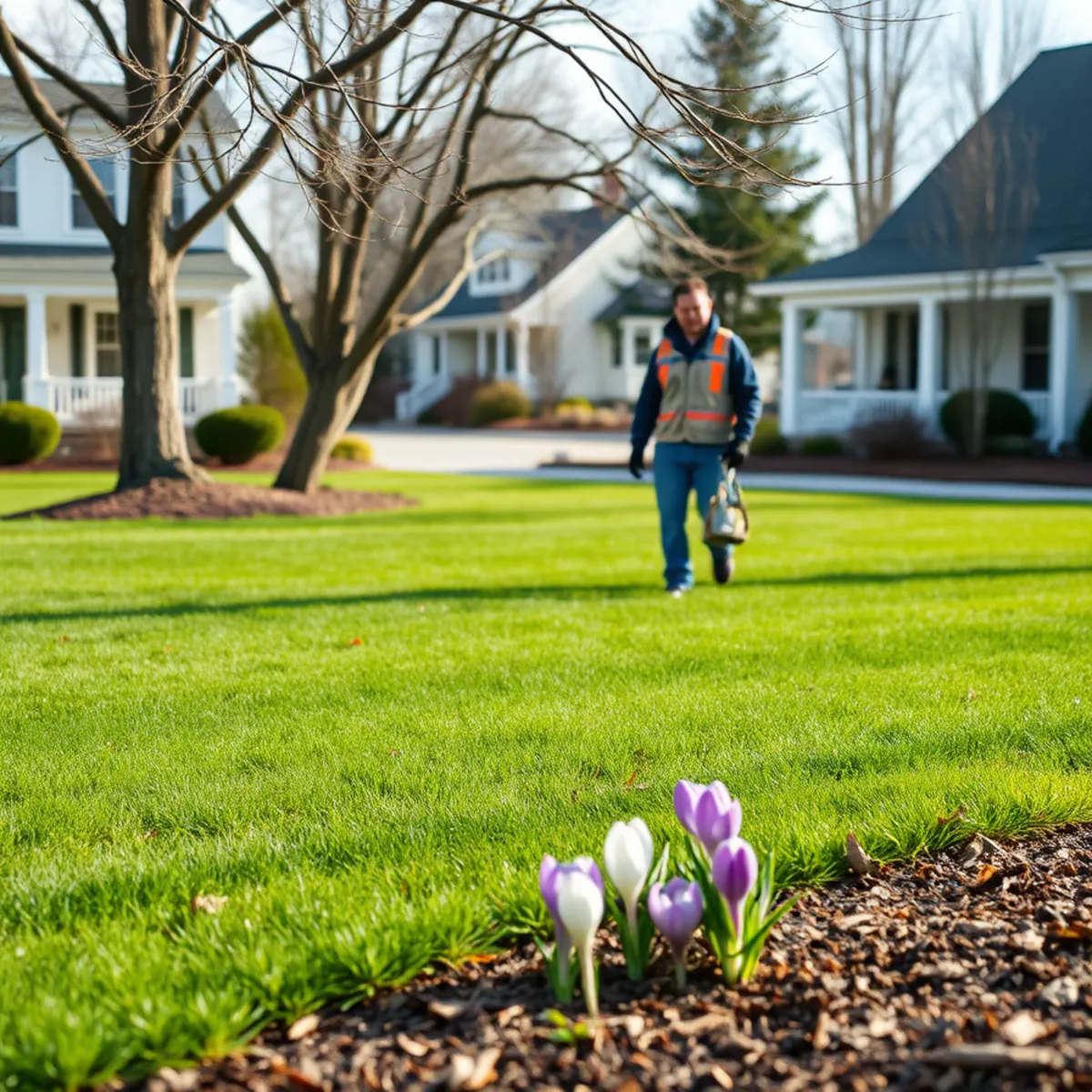
Most lawn care advice online is written for the whole country, which makes it useless in February and actively wrong in June. Whitman sits in USDA hardiness zone 6b with cool-season grass, acidic soil, and a growing season that is genuinely short at both ends. Here is what we actually do, month by month, on the lawns we maintain here.
January and February — plan, do not touch
Nothing happens on a dormant lawn, and that is fine. Frozen turf is brittle, so keep foot traffic off it — a path worn across a frozen lawn in January shows up as a dead stripe in April.
Watch where snow gets piled. Plow banks loaded onto turf compact it and hold ice into spring, which is one of the main causes of the matted gray patches people find in March. If you have a plow contract, the stacking locations should be agreed before the first storm — that is part of how we set up snow removal in Whitman.
February is the right month to book spring work. Cleanup schedules fill fast and the pre-April-15 slots go first.
March — get the property clear
Once the ground has drained enough that you do not leave footprints, spring cleanup starts. Winter sand from the road, matted leaves, storm debris, and the thatch layer that formed under snow all come off. Clearing that material lets soil warm faster, which means an earlier green-up.
Do not work saturated soil. Walking and raking wet ground compacts it, and compaction is the thing you will spend the rest of the year fighting. Wait for it to dry.
Sharpen the mower blade now. A dull blade tears grass rather than cutting it, and torn tips lose moisture and invite disease.
April — the busiest month
Finish cleanup before April 15. After that, perennials push and bulbs come up, and raking beds means tearing out growth you paid for last year. Full details on the sequence are in our spring cleanup checklist for South Shore properties.
Crabgrass pre-emergent goes down when soil temperature at the surface holds around 55°F for several consecutive days — typically mid-April here, though it shifts a week or two with the season. The classic local marker is when forsythia finishes blooming. Skip pre-emergent entirely if you plan to seed, because it stops grass seed germinating just as effectively.
Mulch goes down before the heavy April rains, while beds are still workable and before weed seed germinates. Two to three inches, never more, and pulled back off every trunk.
First mow happens when growth actually starts, usually mid-to-late April. Cut at three inches and take no more than a third of the blade.
May — peak growth
Cool-season grass grows hardest in May. Weekly mowing is not optional this month; a two-week gap means removing far more than a third of the blade in one pass, which stresses the plant and leaves clumps.
A balanced feeding with slow-release nitrogen carries the lawn into summer. Spot-treat broadleaf weeds rather than blanket spraying — dandelions and plantain are easy to hit individually.
This is also the window for spring planting. Shrubs and perennials installed in May have the whole season to establish, provided they get watered through the first summer.
June — raise the deck
Growth starts slowing as temperatures climb. Raise the mowing height to three and a half inches or higher. Taller grass shades its own root zone, holds soil moisture, and blocks the light crabgrass needs. It is the cheapest weed control available.
Start watching irrigation. One inch per week including rainfall, delivered in one or two deep sessions rather than daily light ones. Our guide on how often to water a lawn in Massachusetts covers the measurement method.
June is the main shearing window for formal hedges — new growth on yew, boxwood, and privet has hardened enough to cut cleanly.
July and August — survival mode
Do not push nitrogen into a heat-stressed cool-season lawn. Feeding heavily in July causes disease rather than growth. Keep the deck high, water deeply and infrequently, and let the lawn ride it out.
Grub damage shows up in late summer as turf that peels back like carpet, often with skunks or crows digging. Treatment timing for grubs is largely preventive, so if you had damage last year, this is not the month to start.
A dormant lawn is not a dead lawn. If watering restrictions are in effect, roughly a half inch every two or three weeks keeps the crowns alive and the lawn recovers when rain returns.
Late August is when the year turns. Book aeration now — September fills up.
September — the most important month
If you do one thing for your lawn all year, do it now. Core aeration with overseeding, done in September, produces more improvement than every other service combined. Soil is still warm so seed germinates fast, air is cooling, rain is more reliable, and crabgrass is finished for the year.
Follow aeration with starter fertilizer and lime, if your soil test calls for it, — the open holes give lime a direct path to the root zone instead of leaving it sitting on the surface for a year. The full method is in our fall aeration and overseeding guide.
September is also the best planting month of the year for shrubs and trees. Warm soil, cool air, reliable moisture.
October — feed and start clearing
The most valuable fertilizer application of the year goes down now. Fall feeding goes into root development and carbohydrate storage rather than top growth, which is what carries the lawn through next summer.
Start removing leaves before they mat. Wet leaves left on turf smother it within days and set up snow mold. If you have mature oaks, plan on two passes — they drop weeks after the maples finish. That is covered in our fall leaf removal guide.
Lime goes down in late fall so winter moisture works it in over the following months.
November — finish clean
Final mow at around two and a half inches, shorter than the summer height. Long grass folds over under snow and mats, which is exactly what snow mold needs.
Second leaf pass on wooded properties. Everything that stays on the lawn through winter is a problem in April.
Winterize the irrigation system before a hard freeze. Water left in pipes and heads splits them.
December — done for the year
Nothing left to do but keep traffic off frozen turf and watch where snow gets stacked. If you want next spring to be easy, the work that makes it easy already happened in September and October.
The short version
| When | The one thing that matters |
|---|---|
| March | Clear the property once soil drains |
| Before April 15 | Finish spring cleanup |
| Mid-April | Pre-emergent at 55°F soil temp — unless seeding |
| May | Weekly mowing, no exceptions |
| June | Raise the mowing height |
| July–August | Stop feeding, water deeply, wait it out |
| September | Aerate and overseed |
| October | Best feeding of the year, start leaves |
| November | Short final mow, second leaf pass, winterize |
If keeping to that schedule sounds like more than you want to manage, that is what a maintenance program does. We run this calendar on properties across Whitman and the surrounding South Shore towns, and the lawns that stay on it look noticeably different by the second year.
Frequently Asked Questions
Core aeration with overseeding in September, paired with lime if your soil test calls for it. Nothing else comes close in terms of improvement per dollar on an established cool-season lawn.
When growth genuinely stops, usually somewhere in November. Make the last cut shorter than your summer height — around two and a half inches — so grass does not fold over and mat under snow.
Want this handled for you?
We do this work across Whitman and the South Shore every week. Call (323) 606-0255 for a free on-site estimate — we will tell you honestly what your property needs.